
This section contains carefully selected MCQs and Previous Year Questions with explanations to help students understand concepts and prepare effectively for examinations, interviews, and competitive tests.
Q: 1Which of the following is not a type of Network Topology?
Option A
Network Topology refers to the physical or logical arrangement of computers and communication devices in a network. It defines how different devices are connected and how data travels in the network.
| Network Topology | Description |
|---|---|
| Bus Topology | In bus topology, all computers are connected to a single main communication cable called backbone cable. |
| Star Topology | In star topology, all computers are connected to a central hub or switch. |
| Ring Topology | In ring topology, each computer is connected to two neighboring computers forming a circular path. |
| Mesh Topology | In mesh topology, every computer is directly connected to every other computer in the network. |
| Tree Topology | In tree topology, multiple star networks are connected in a hierarchical structure. |
| Hybrid Topology | In hybrid topology, two or more different topologies are combined together. |
| Point-to-Point Topology | In point-to-point topology, two devices are directly connected with each other. |
| Daisy Chain Topology | In daisy chain topology, devices are connected one after another in a sequence. |
Q: 2Let us assume that there are four (4) network segments in Bus topologies A1—A2, B1—B2—B3, C1—C2 and D1—D2—D3. If A1, B1, C1 and D1 are interconnected in mesh, then how many mesh connections are required?
Option B
Given 4 network segments represented by points A1, B1, C1, and D1 interconnected in a mesh, we need to find the total number of mesh connections.
With 4 nodes the number of connections is [4(4-1)/2] = [4*3/2] = 12/2 = 6.
Q: 3Which of the following statement(s) is/are correct?
I. Metropolitan Area Network is a collection of Local Area Network.
II. Metropolitan Area Network support both data and voices transmission.
Option C
A Metropolitan Area Network (MAN) is a computer network designed to cover a city or a large metropolitan area.
It is larger than a LAN but smaller than a WAN. A MAN can connect multiple Local Area Networks (LANs) located at different places within a city. Therefore, Statement I is True.
A MAN can carry different types of communication, including data and voice transmission.
For example, a metropolitan network can be used to provide internet connectivity as well as telephone or voice communication services across different locations. Therefore, Statement II is also True.
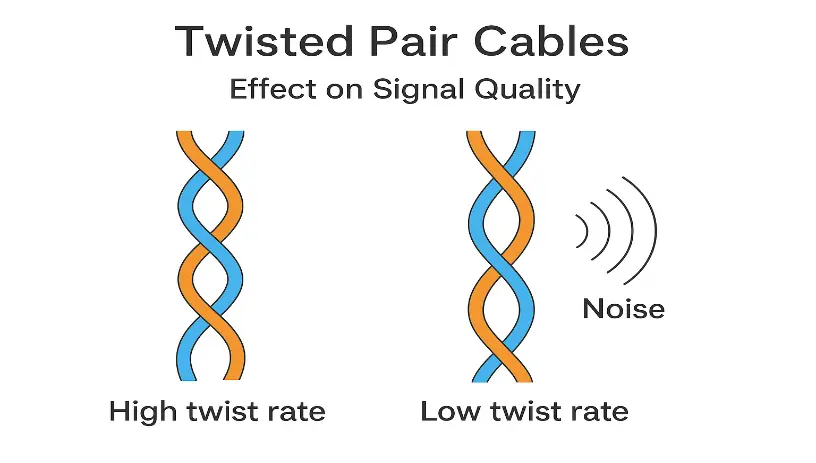
Q: 4Which of the following statements about twists in twisted pair cables is TRUE?
Option C
Twisted pair cables are a type of electrical cable commonly used in networking and telecommunications.
Twisted pair cables consist of two insulated copper conductors twisted together to reduce electromagnetic interference (EMI) and crosstalk between adjacent pairs and improves overall signal quality.
Q: 5Choose WRONG statement about packet switching
Option B
Packet Switching is a data transmission method where data is broken into small units called Packets, and each packet can travel independently across the network.
Q: 6How many maximum links can be created in a mesh topology network of n computers?
Option D
In a Mesh Topology, every computer is directly connected to every other computer. If there are N computers, each computer can connect to N-1 other computers.
At first, it may seem that the total number of links should be N(N-1). However, this counts each link twice.
For example, the connection between Computer A and Computer B is the same physical link as the connection between B and A. Therefore, we divide by 2.
Maximum Links = (N(N-1))/2
Q: 7In which topology, if there are n devices in a network each device has n-1 ports for connecting through cables
Option A
In computer networks, Topology defines how devices are connected to each other. Different topologies require different numbers of connections like ports and cables.
In a mesh topology, every device is directly connected to every other device. So, if there are n devices, each device must connect with (n-1) other devices. Therefore, each device needs (n-1) ports.
Q: 8Which of the following is not a LAN technology?
Option D
A LAN is a network used to connect computers and other devices within a relatively small geographical area, such as a home, office, school, or building. Ethernet, Token Ring, and FDDI (Fiber Distributed Data Interface) are technologies that have been used for LAN communication.
Ethernet is the most widely used LAN technology, while Token Ring and FDDI are older LAN technologies.
Frame Relay is a WAN (Wide Area Network) technology designed for communication over larger geographical areas. It uses virtual circuits to transfer data between different locations through a service providers network.
Q: 9Which standard is used to define protocol, host computer, port and path on the Internet?
Option B
When we access a webpage or any resource on the Internet, we use an address that tells the computer where to find it. This address is called a URL (Uniform Resource Locator). It includes several parts such as the protocol, host computer, port, and path.
URL example, https://www.surakuacademy.com/rpsc-vice-principal-iti-information-technology-paper-solution
| PART | DESCRIPTION | EXAMPLE |
|---|---|---|
| Protocol | Communication method such as HTTP, HTTPS, FTP. | https |
| Host | Domain name or IP address of the server. | www.surakuacademy.com |
| Port | Connection port, optional, tells which service or connection point to use. Common default ports are 80 for HTTP and 443 for HTTPS. | 443 |
| Path | The specific file or page inside the website. Specifies the exact location or file on the host server. | /rpsc-vice-principal-iti-information-technology-paper-solution |
Q: 10There are n stations in a slotted LAN. Each station attempts to transmit with a probability p in each time slot. What is the probability that only one station transmits in a given time slot?
Option C
In a slotted LAN, all n stations get a chance to send data in every time slot. Each station tries to send with a probability p. To find the probability that only one station sends data, we think about two things:
Because any one of the n stations could be the one that transmits successfully, we multiply by n. So, the probability that only one station transmits is n×p×(1−p)n−1.
You have reached the end of this topic. Continue learning with the next topic below.
Thank you so much for taking the time to read my Computer Science MCQs section carefully. Your support and interest mean a lot, and I truly appreciate you being part of this journey. Stay connected for more insights and updates! If you'd like to explore more tutorials and insights, check out my YouTube channel.
Don’t forget to subscribe and stay connected for future updates.
| Student Name | |
|---|---|
| College |
| What's Say |
|---|