
This section contains carefully selected MCQs and Previous Year Questions with explanations to help students understand concepts and prepare effectively for examinations, interviews, and competitive tests.
Q: 1The characteristic equation of the T flip-flop is
Option B
The characteristic equation of a flip-flop defines the next state Q(n+1) in terms of the present state Q(n) and the input. In the case of a T flip-flop, when T = 0, the output remains unchanged, meaning the next state is the same as the present state. When T = 1, the flip-flop toggles, so the next state becomes the complement of the present state.
This behavior can be expressed mathematically as: Q(n+1) = T ⊕ Q(n) which is equivalent to Q(n+1) = T·Q̅(n) + T̅·Q(n).
Q: 2In a positive edge triggered JK flip-flop, when J=0, K=1 and Q=0, what happens to Q when the clock input goes HIGH and when the clock input goes LOW?
Option A
A positive edge triggered JK flip-flop changes its output only at the rising edge of the clock.
A rising edge (positive edge) is the moment when a digital signal changes from LOW (0) to HIGH (1).
In digital electronics, clock signals are square waves that continuously switch between 0 and 1. The transition from:
0 to 1 (LOW to HIGH) is called the Rising Edge.
1 to 0 (HIGH to LOW) is called the Falling Edge.
First, recall the JK flip-flop truth table:
| J | K | QN+1 | Operation |
|---|---|---|---|
| 0 | 0 | QN | No Change |
| 0 | 1 | 0 | Reset |
| 1 | 0 | 1 | Set |
| 1 | 1 | Q’N | Toggle |
When clock goes HIGH:
Since it is positive edge triggered, the flip-flop responds only at the rising edge. At this moment, reset condition applies, so, Q becomes 0. But Q was already 0. So, it remains 0.
When clock goes LOW:
After the rising edge, the flip-flop does not respond to further clock level changes. So, Q remains unchanged (still 0).
Q: 3A flip-flop is capable of storing ___________ information.
Option B
A flip-flop is a basic sequential circuit used to store binary information. Since binary information has only two possible values, 0 and 1, a flip-flop has two stable states and can store either a 0 or a 1 at a time. Therefore, one flip-flop stores exactly one bit of information.
Q: 4In the given sequential circuit if the initial value of Q1Q0 = 00, then what are the next three values of Q1Q0?
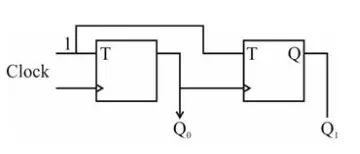
Option B
The given circuit contains two T Flip-Flops. A T Flip-Flop changes (toggles) its output whenever value of T is 1and a clock pulse is applied.
In the circuit:
Initial state is given as: Q1Q0 = 00
| Clock Pulse | Q0 Change | Q1 Change | New State (Q1Q0) |
|---|---|---|---|
| Initial | — | — | 00 |
| 1st Pulse | Q₀ Toggle from 0 to 1 | Q₁ Toggles from 0 to 1 | 11 |
| 2nd Pulse | Q₀ Toggle from 1 to 0 | No Toggle (No Change) | 10 |
| 3rd Pulse | Q₀ Toggle from 0 to 1 | Q₁ Toggles from 1 to 0 | 01 |
Thus, the next three states (Q1Q0) are 11, 10, 01.
Q: 5Which of the following pair is/are correct?
I. Astable Multivibrator – Flip-Flop
II. Bistable Multivibrator – Free Running
Option D
A Multivibrator is a type of electronic circuit used for generating or storing binary signals. Multivibrators are mainly classified into astable, monostable, and bistable types.
An Astable Multivibrator has no stable state. It continuously switches between two states without requiring an external trigger. Therefore, it is also called a free-running multivibrator.
A Monostable Multivibrator has one stable state and one temporary state. Normally, it remains in its stable state. When an external trigger is applied, it temporarily changes to the other state and then automatically returns to its stable state after a certain time.
A Bistable Multivibrator has two stable states and can remain in either state until an external trigger changes it to the other state. A flip-flop is an example of a bistable circuit.
| Feature | Astable | Monostable | Bistable |
|---|---|---|---|
| Number of Stable States | 0 | 1 | 2 |
| External Trigger Required | No | Yes | Yes |
| Automatically Changes State | Yes | Returns automatically after temporary state. | No |
| Output | Continuous Pulses | Single Pulse | One of two stable levels. |
| Other Name | Free-Running | One-Shot | Flip-Flop |
| Common Application | Clock generation. | Timing and pulse generation. | Memory and data storage. |
Q: 6Which of the following options is not true for a gated D-type flip-flop?
Option D
A gated D-type flip-flop is a sequential circuit that stores one bit of data. The transfer of input D to output Q is controlled by a clock signal.
When the clock is high (1), the flip-flop becomes active and the input data D is transferred to the output Q.
When the clock is low (0), the flip-flop does not allow the input to pass through and the previous value stored in Q is maintained.
Q: 7When does a negative level triggered flip-flop in Digital Electronics changes its state?
Option A
A negative level triggered flip-flop is a type of flip-flop that changes its state only when the clock signal is at the low level (0). In other words, when the clock remains at a negative (low) voltage level, the flip-flop becomes active and responds to inputs.
Q: 8A monostable multivibrator has which of the following state(s)?
I. One Stable State.
II. One Quasi-Stable State.
Option C
A monostable multivibrator is a type of multivibrator circuit that has one stable state and one quasi-stable (temporary) state. It is also called a one-shot multivibrator because it generates a single output pulse when an external trigger is applied.
The circuit normally remains in its stable state. When a trigger pulse is applied, it temporarily moves to its quasi-stable state. After a predetermined time, it automatically returns to its stable state.
| Multivibrator | Stable States | Quasi-Stable States |
|---|---|---|
| Astable | 0 | 2 |
| Monostable | 1 | 1 |
| Bistable | 2 | 0 |
Q: 9Which of following circuit is used as a memory device in computer?
Option A
A memory device is used to store information so that it can be used later. A Flip-Flop is a binary cell that capable of storing one bit of information. The flip-flop has two stable states either 0 called RESET or 1 called SET.
Q: 10What is the correct answer of the given statements in the given order?
I. Gate in which output of logical gate is high when all inputs are high is ________
II. Half of byte is known as ________
III. A flip-flop whose output follows the input when triggered is ________
Option C
A logic gate whose output becomes high (1) only when all inputs are high is called an AND Gate.
| A | B | Output |
|---|---|---|
| 0 | 0 | 0 |
| 0 | 1 | 0 |
| 1 | 0 | 0 |
| 1 | 1 | 1 |
A byte contains 8 bits. Half of a byte means 4 bits. A group of 4 bits is called a Nibble.
A D Flip-Flop is a flip-flop whose output follows the input when the clock signal is triggered.
You have reached the end of this topic. Continue learning with the next topic below.
Thank you so much for taking the time to read my Computer Science MCQs section carefully. Your support and interest mean a lot, and I truly appreciate you being part of this journey. Stay connected for more insights and updates! If you'd like to explore more tutorials and insights, check out my YouTube channel.
Don’t forget to subscribe and stay connected for future updates.
| Student Name | |
|---|---|
| College |
| What's Say |
|---|