
This section contains carefully selected MCQs and Previous Year Questions with explanations to help students understand concepts and prepare effectively for examinations, interviews, and competitive tests.
Q: 1What is a data structure?
Option D
A data structure is particular way of storing and organizing data in computer system. So that it can be used efficiently.
Q: 2Which of the following is a linear data structure?
Option A
Q: 3Which of the following is NOT a basic operation performed on a data structure?
Option A
Data structure is way of storing and organizing data in a computer so that it can be used efficiently. For example, dictionary is good example of organized data in which the words are arranged in a particular order.
| OPERATION | DESCRIPTION |
|---|---|
| Insertion | Adding a new element to the data structure. |
| Deletion | Removing an existing element from the data structure. |
| Traversal | Accessing or visiting each element of the data structure. |
| Searching | Finding whether a particular element exists or not. |
| Sorting | Arranging elements in a particular order either in ascending or descending. |
| Update | Changing the value of an existing element. |
Q: 4Identify the correct statement given below
Option B
Data structures are classified as linear and non-linear based on how elements are arranged.
In non-linear data structures, elements are not arranged sequentially, instead, they have Hierarchical or Network relationships.
A Graph consists of nodes (vertices) connected by edges and does not follow a linear sequence, so it is a non-linear data structure.
Q: 5The data structure which is best suited for random access is _____________.
Option A
Random access means accessing any element directly using its index without traversing other elements.
An Array is best suited for this because it stores elements in contiguous memory locations, allowing direct access using an index as arr[i]. This makes access very fast with constant time complexity O(1).
Q: 6Which data structure is mainly used for implementing the recursive algorithm?
Option B
Recursion is a technique where a function calls itself to solve smaller versions of the same problem until reaching a simple base case that stops the calls.
When a function calls itself, the computer must remember the current state of the function before jumping to the next call. To manage these multiple pending function calls, the system uses a stack.
Each time a function is called, a stack frame is pushed onto the stack, and when the function returns, the stack frame is popped.
Q: 7Which of the following statements is true about Big-O notation?
Option B
Big-O notation is used to describe how fast an algorithm grows in terms of its input size (n). It helps us understand the worst-case (upper bound) performance of an algorithm.
Q: 8Which of the following data structures stores elements in a non-linear relationship?
Option D
A Data Structure is a way of storing and organizing data in computer system so that it can be used efficiently. Different data structures are used depending on what operations we need. Choosing the right data structure makes programs faster and easier to manage.
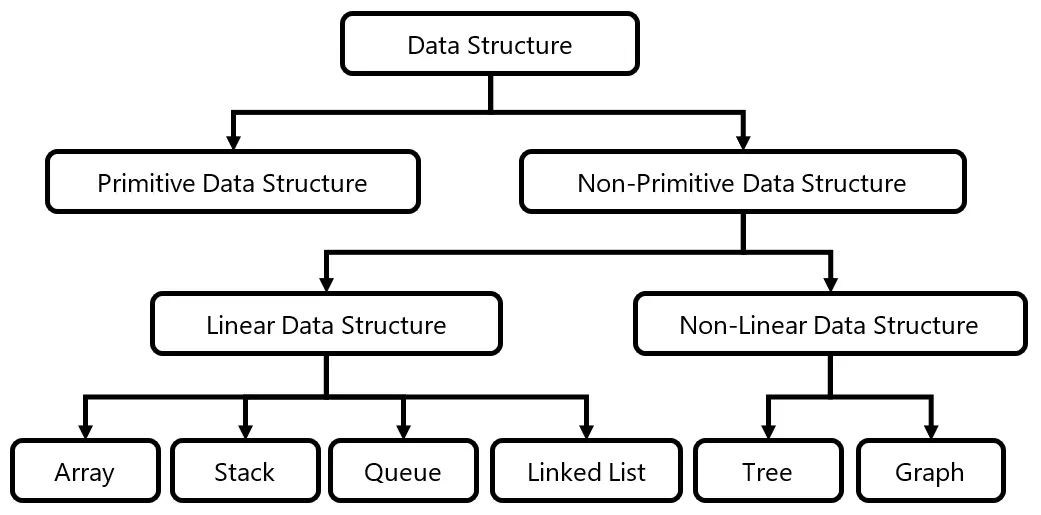
In a Linear data structure, elements are arranged one after another in a sequence. Each element has a unique predecessor and unique successor, except the first and last elements. Array, Stack, Queue, Linked List are example of linear data structure.
In a Non-Linear data structure, elements are not arranged sequentially. An element can connect to multiple elements, forming structures like hierarchical or networks. Tree and Graph are example of non-linear data structure.
Q: 9Identify the non-linear data structures from among the following.
(i) Linked List
(ii) Stack
(iii) Tree
Option B
A data structure is a way of organizing and storing data so that it can be accessed and modified efficiently. Data structures are broadly classified into Linear and Non-Linear data structures.
In a Linear Data Structure, elements are arranged sequentially, and each element has a unique predecessor and successor except the first and last elements.
E.g.:
In a Non-Linear Data Structure, elements are organized hierarchically or in a network, so one element can be connected to multiple other elements.
E.g.:
| Feature | Linear Data Structure | Non-linear Data Structure |
|---|---|---|
| Arrangement | Elements are stored sequentially. | Elements are arranged hierarchically or as a network. |
| Relationship | One-to-one relationship. | One-to-many or many-to-many relationship. |
| Traversal | Sequential traversal. | Multiple traversal paths are possible. |
Q: 10An Abstract Data Type (ADT) is?
Option C
An Abstract Data Type (ADT) is a data type that is defined by the set of operations that can be performed on it, not by how it is implemented.
Users of an ADT can only use the operations specified in its definition, while the internal representation and implementation details are hidden.
Thank you so much for taking the time to read my Computer Science MCQs section carefully. Your support and interest mean a lot, and I truly appreciate you being part of this journey. Stay connected for more insights and updates! If you'd like to explore more tutorials and insights, check out my YouTube channel.
Don’t forget to subscribe and stay connected for future updates.
| Student Name | |
|---|---|
| College |
| What's Say |
|---|