
This section contains carefully selected MCQs and Previous Year Questions with explanations to help students understand concepts and prepare effectively for examinations, interviews, and competitive tests.
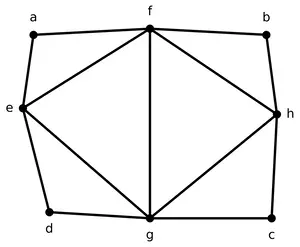
Q: 1What is the chromatic number of the graph shown below?
Option B
The chromatic number of a graph is the minimum number of colors required to color the vertices so that no two adjacent vertices have the same color.
In the given graph, vertices such as e, f, g, and h form a structure where each is connected in a way that three colors are not sufficient to avoid conflicts between adjacent vertices. When we attempt coloring with 3 colors, at least two adjacent vertices will end up with the same color.
However, using 4 colors, we can assign colors to all vertices so that no adjacent vertices share the same color. Therefore, the minimum number of colors required is 4.
Q: 2
Match the following table showing algorithm and its application.
| Application | Algorithm |
|---|---|
| (P) A person wants to visit from one place to another place in shortest period | (i) Floyd’s algorithm |
| (Q) A person wants to visit M places in shortest period | (ii) Multi-stage graph algorithm |
| (R) All N persons want to visit all M places in shortest | (iii) Dijkstra’s algorithm |
Option A
Different Shortest-Path Algorithms are designed for different types of path problems in graphs. The key is to identify how many sources and destinations are involved and what type of path computation is required.
(P) A person wants to visit from one place to another place in the shortest period.
A Multi-Stage Graph Algorithm divides the graph into stages and computes the shortest path from the source to the destination using dynamic programming. It is commonly used when the movement must follow a stage-wise structure.
(Q) A person wants to visit M places in shortest period.
Dijkstra’s Algorithm computes the shortest path from a single source vertex to all other vertices in a weighted graph with non-negative edges.
(R) All N persons want to visit all M places in shortest.
Floyd’s Algorithm computes the shortest paths between every pair of vertices in a graph using dynamic programming and an adjacency matrix.
| ALGORITHM | DESCRIPTION | APPLICATION |
|---|---|---|
| Dijkstra’s Algorithm | Greedy Algorithm used to compute shortest path from a single source to all other vertices in a weighted graph. Uses Priority Queue. Works only when edge weights are non-negative. Faster than Bellman–Ford but cannot handle Negative Edges. | GPS navigation. Routing protocols. Shortest path in road networks. |
| Floyd–Warshall Algorithm | Dynamic Programming algorithm used to compute shortest paths between every pair of vertices (All-Pairs Shortest Path). Uses adjacency matrix and considers intermediate vertices one by one. Works even with negative weights but not negative cycles. | Network routing tables. Computing distances between all cities. |
| Bellman–Ford Algorithm | Computes single-source shortest paths by repeatedly relaxing all edges V-1 times. Can detect negative weight cycles. Slower than Dijkstra but more general because it supports Negative Edges. | Currency exchange systems. Networks with negative cost edges. |
| Multi-Stage Graph Algorithm | Uses Dynamic Programming for graphs divided into multiple stages. Computes shortest path from source to destination through sequential stages. Each stage only connects to the next stage. | Production scheduling. Pipeline processing. Stage-based decision problems. |
| Prim’s Algorithm | Greedy Algorithm that constructs a Minimum Spanning Tree (MST) by expanding a tree from a starting vertex and always selecting the smallest edge connecting the tree to a new vertex. | Designing communication networks. Power grids. |
| Kruskal’s Algorithm | Greedy Algorithm that builds Minimum Spanning Tree (MST) by sorting edges in increasing order and adding them if they do not form a cycle. Uses Disjoint Set (Union–Find) for cycle detection. | Road construction planning. Network cable layout. |
| Warshall’s Algorithm | Computes transitive closure of a graph using adjacency matrix. Determines whether a path exists between every pair of vertices (reachability problem). | Database query optimization. Dependency analysis. |
| Breadth First Search (BFS) | Graph Traversal technique that explores vertices level by level using a queue. Guarantees shortest path in unweighted graphs. | Social network analysis. Shortest path in unweighted graphs. |
| Depth First Search (DFS) | Traversal method that explores vertices deeply before backtracking using stack. Useful for cycle detection, connected components, topological sorting. | Compiler design. Maze solving. Graph connectivity. |
Q: 3The maximum number of edges in a ‘n’ node undirected graph without self—loop is
Option B
In an undirected graph with n nodes and no self‑loops, the maximum number of edges occurs when every pair of distinct nodes is connected by exactly one edge. That is, the graph is a Complete Graph Kn.
Q: 4If a graph has 31 edges and each vertex of the graph has degree atleast 3, then maximum number of possible vertices in the graph is
Option B
We use the Handshaking Theorem, which states that the sum of the degrees of all vertices in an undirected graph equals twice the number of edges:
Sum of degrees of all vertices=2×Number of edges
Here, E=31. So,
Sum of degrees = Sum of degrees=2×31=62
The given condition is that each vertex has degree at least 3. Now, let the number of vertices be n. Then, Sum of degrees ≥ 3n. We already know the exact sum is 62, so, 3n ≤ 62.
Finally solve for n, n ≤ 62/3 = 20.66. Since the number of vertices must be an integer, the maximum possible number of vertices is 20.
Q: 5Which of the following is correct?
Option A
A tree is a special type of graph that is connected and acyclic. This means all nodes are reachable from each other, and there is exactly one unique path between any two nodes.
Q: 6Spanning tree of a graph with V vertices has—
Option D
A Spanning Tree of a graph is a subgraph that includes all the vertices of the graph and is connected without forming any cycles. For any connected graph with V vertices, a tree structure must have exactly V-1 edges to remain connected and acyclic.
Q: 7Consider an undirected un-weighted graph G. Let a breadth first traversal of G be done starting from a node r. let d(r,u) and d(r,v) be the length of the shortest path from r to u and v respectively in G. if u is visited before v during the breadth first traversal, which of the following statement is correct?
Option C
Breadth First Search (BFS) is a graph traversal technique where we start from a chosen root vertex r and explore all the neighboring vertices first. It uses a Queue to keep track of which vertices to visit next.
What does d(r,u) mean?
Here d(r,u) represents the shortest distance from the root vertex r to vertex u, measured in terms of the number of edges on the shortest path connecting them. In an unweighted graph, this shortest distance is exactly the same as the level at which vertex u sits during the breadth first traversal.
The fundamental property of BFS is that it visits all vertices at distance 0 first, which is just the root itself, then all vertices at distance 1, then all vertices at distance 2, and so on, expanding outward layer by layer using the queue structure.
The question tells us that vertex u is visited before vertex v during the breadth first traversal. Since BFS always processes vertices in non-decreasing (increasing) order of their distance from the root, this means the distance of u from the root cannot be greater than the distance of v from the root.
This gives us d(r,u) ≤ d(r,v).
It is important to notice that this relationship uses less than or equal to, not strictly less than. This is because multiple vertices can exist at the exact same distance level from the root.
E.g.:
Consider the following given Graph-1.
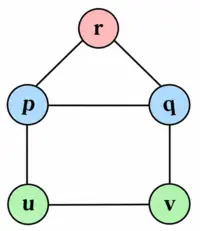
As we know, BFS explores an undirected graph level by level. The important property is that vertices are visited in non-decreasing order of their shortest distance from the starting vertex r.
Graph 1: Vertices u and v are at the same distance, so, starting from r:
So, d(r,u)=2 and d(r,v)=2. BFS may visit u before v, or v before u, depending on the order in which adjacent vertices are processed. If u is visited before v, we have d(r,u)=d(r,v)=2. Therefore, d(r,u)≤d(r,v), means, strict inequality d(r,u)<d(r,v) is not necessary.
E.g.:
Consider the following given Graph-2.
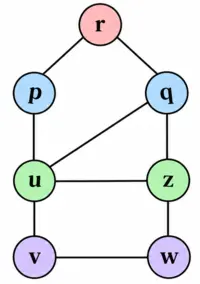
Graph 2: Vertices u and v are not at the same distance, so, starting from r:
Therefore, d(r,u)=2 while d(r,v)=3. BFS will visit the level containing u before reaching the level containing v. Thus, d(r,u)<d(r,v).
So, if u is visited before v, the only guaranteed relationship is d(r,u)≤d(r,v). We cannot guarantee d(r,u)<d(r,v) because u and v can be at the same BFS level.
In short, BFS always visits vertices in increasing order of their shortest distance from the source. So, if u is visited before v, the distance of u can be less than or equal to the distance of v.
Q: 8A graph is a collection of nodes called ________ and line segments called _______ that connect pairs of nodes.
Option B
In graph theory, a graph is made up of a set of nodes, which are technically called vertices, and a set of line segments that connect pairs of these nodes, which are called edges.
Vertices represent the objects or points in the graph, while edges represent the connections or relationships between them.
Q: 9The time complexity of Depth First Search (DFS) using an adjacency list is:
Option A
Depth First Search (DFS), is a graph traversal technique where we start from a chosen vertex and travel as deep as possible along one path before backtracking and exploring other paths. It uses either a stack or recursion to keep track of which vertices still need to be explored.
The time complexity of Depth First Search (DFS) depends on how the graph is represented. For an adjacency list, DFS performs the following:
Therefore, the total time complexity is O(V+E)
| Graph Representation | DFS | BFS |
|---|---|---|
| Adjacency List | O(V+E) | O(V+E) |
| Adjacency Matrix | O(V2) | O(V2) |
Q: 10Consider an undirected graph G. Let a breadth-first traversal of G be done staring from node r. Let d(r,u) and d(r,v) be the length of the shortest path from r to u and v respectively in G. If u is visited before v during the breadth-first traversal which of the following is correct?
Option A
Breadth First Search (BFS) is a graph traversal technique where we start from a chosen root vertex r and explore all the neighboring vertices first. It uses a Queue to keep track of which vertices to visit next.
What does d(r,u) mean?
Here d(r,u) represents the shortest distance from the root vertex r to vertex u, measured in terms of the number of edges on the shortest path connecting them. In an unweighted graph, this shortest distance is exactly the same as the level at which vertex u sits during the breadth first traversal.
The fundamental property of BFS is that it visits all vertices at distance 0 first, which is just the root itself, then all vertices at distance 1, then all vertices at distance 2, and so on, expanding outward layer by layer using the queue structure.
The question tells us that vertex u is visited before vertex v during the breadth first traversal. Since BFS always processes vertices in non-decreasing (increasing) order of their distance from the root, this means the distance of u from the root cannot be greater than the distance of v from the root.
This gives us d(r,u) ≤ d(r,v).
It is important to notice that this relationship uses less than or equal to, not strictly less than. This is because multiple vertices can exist at the exact same distance level from the root.
E.g.:
Consider the following given Graph-1.
As we know, BFS explores an undirected graph level by level. The important property is that vertices are visited in non-decreasing order of their shortest distance from the starting vertex r.
Graph 1: Vertices u and v are at the same distance, so, starting from r:
So, d(r,u)=2 and d(r,v)=2. BFS may visit u before v, or v before u, depending on the order in which adjacent vertices are processed. If u is visited before v, we have d(r,u)=d(r,v)=2. Therefore, d(r,u)≤d(r,v), means, strict inequality d(r,u)<d(r,v) is not necessary.
E.g.:
Consider the following given Graph-2.
Graph 2: Vertices u and v are not at the same distance, so, starting from r:
Therefore, d(r,u)=2 while d(r,v)=3. BFS will visit the level containing u before reaching the level containing v. Thus, d(r,u)<d(r,v).
So, if u is visited before v, the only guaranteed relationship is d(r,u)≤d(r,v). We cannot guarantee d(r,u)<d(r,v) because u and v can be at the same BFS level.
In short, BFS always visits vertices in increasing order of their shortest distance from the source. So, if u is visited before v, the distance of u can be less than or equal to the distance of v.
Thank you so much for taking the time to read my Computer Science MCQs section carefully. Your support and interest mean a lot, and I truly appreciate you being part of this journey. Stay connected for more insights and updates! If you'd like to explore more tutorials and insights, check out my YouTube channel.
Don’t forget to subscribe and stay connected for future updates.
| Student Name | |
|---|---|
| College |
| What's Say |
|---|