
This section contains carefully selected MCQs and Previous Year Questions with explanations to help students understand concepts and prepare effectively for examinations, interviews, and competitive tests.
Q: 1Indices whose search key specifies an order different from the sequential order of the file are called—
Option D
An Index in a database is a special data structure that helps the system locate records quickly without scanning the entire table.
Primary Indices correspond to the sequence of the data file itself, meaning the index key and the file are ordered the same way.
Secondary Indices have a search key order that is different from the sequential order of the data file. This allows access to data organized by non-primary keys, where the actual data storage is unrelated to the index ordering.
Q: 2The INSERT operation is fastest in
Option B
In file organization, different methods store and manage records differently, which affects the performance of operations like insert.
A Heap File Organisation stores records in no particular order. New records are simply placed in the first available space (usually at the end of the file).
Since no sorting or searching is required before insertion, this makes the insert operation very fast.
| Technique | Explanation |
|---|---|
| Hash File Organisation | Requires hash computation and possible collision handling. |
| B+ Tree File Organisation | Needs tree traversal and balancing. |
| Clustered File Organisation | Requires maintaining order/grouping of records. |
Q: 3What is the full form of ISAM in file organisation?
Option B
ISAM stands for Indexed Sequential Access Method. It is a file organization method in which records are stored sequentially according to a key field, while an index is maintained to provide faster direct access to a particular record.
ISAM combines the advantages of sequential access and indexed access. In sequential access, records can be processed in their key order, while the index allows the system to locate a required record more quickly without searching the entire file.
Q: 4Consider below statements –
(I) Each non-leaf node in B+ tree has between [n/2] and n children, where n is fixed for a particular tree.
(II) The search key of a clustering index is always primary key.
(III) Secondary indices must be dense.
(IV) In a dense index, an index entry appears for only some of the search-key values.
Which of the above statements are true?
Option C
The statement (I) is true because, in B+ trees, to maintain balance and efficient use of space, the number of children for each internal (non-leaf) node must be at least half of the maximum allowed children, up to the maximum n.
The statement (II) is false because, a clustering index is based on the order in which data records are stored physically. The search key for the clustering index is the attribute(s) on which the file is ordered, which may or may not be the primary key.
The statement (III) is true because, secondary indices typically maintain an index record for every tuple in the data file to provide quick access regardless of the clustering. Hence, secondary indices are dense meaning an index entry exists for every search-key value.
The statement (IV) is false because, by definition, a Dense Index has an index record for every search-key value in the data file. A Sparse Index has entries for only some search-key values.
Q: 5What is the full form of DASD in database management system?
Option A
DASD stands for Direct Access Storage Device. It refers to a storage device in which data can be accessed directly at a specific location, without having to read all the preceding data first.
This makes direct access much faster for retrieving particular records. Examples of DASD include magnetic disks and other direct-access storage devices.
Q: 6Consider the following statements about B+ Trees for indexing in DBMS
I. B+ Trees are self balancing.
II. In B+ Trees, the data pointers are stored only at the leaf nodes.
III. In B+ Trees, the structure of the leaf node and internal nodes will be the same.
Which of the following options is correct?
Option D
B+ Trees are widely used in DBMS for indexing because they maintain data in a balanced and sorted structure, which ensures efficient searching, insertion, and deletion.
Q: 7Primary index in sequential order file organisation is also known as ___________.
Option D
Indexing is a technique used in a database to make the retrieval of records faster and more efficient. DBMS uses an index to locate the required records without scanning the entire data file.
An index generally contains a search-key value and a pointer that helps locate the corresponding record or block of records.
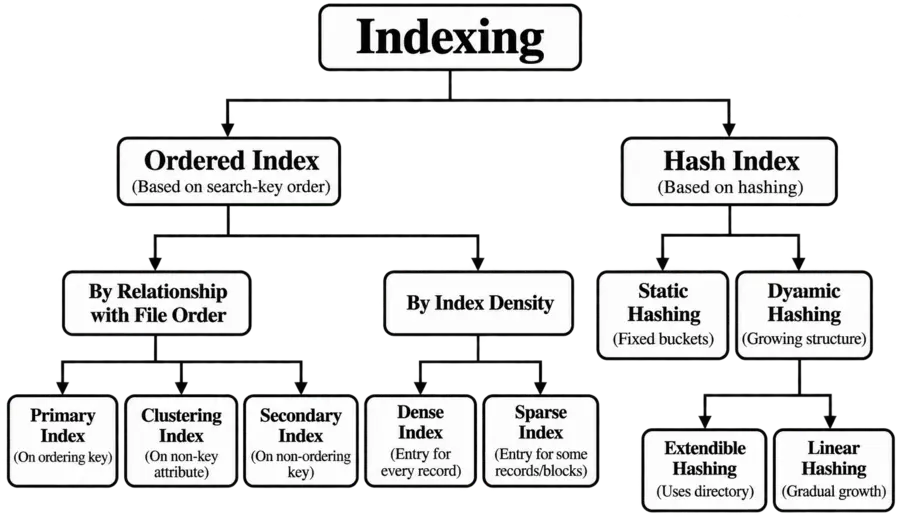
Ordered Index:
An ordered index is an index in which the index entries are maintained in sorted order according to the search-key values.
Ordered indexes are particularly useful when we need to perform range searches, such as finding all students whose roll numbers are between 100 and 120.
Primary Index:
A primary index is an index created on a file that is physically ordered according to its primary key or ordering key. Means,
Suppose student records are stored according to Roll_No. as 101, 105, 110, 115, 120, 125.
If the file is physically arranged according to Roll_No, an index created on Roll_No is called a Primary Index.
Note:
Clustering Index:
A clustering index is an index used when the records in a file are physically ordered according to a non-key attribute, called the clustering field.
For example, consider employee records arranged according to Department:
| Employee | Department |
|---|---|
| E1 | HR |
| E2 | HR |
| E3 | IT |
| E4 | IT |
| E5 | Sales |
| E6 | Sales |
Here, Department is a non-key attribute because several employees can have the same department. A clustering index can point to the beginning of each group:
| Department | Pointer |
|---|---|
| HR | HR Group |
| IT | IT Group |
| Sales | Sales Group |
Thus, instead of identifying a single record, the index helps locate a group of records having the same clustering-field value. Clustering Index → Non-key Ordering Field.
Secondary Index:
A secondary index is an index created on a search key that does not determine the physical ordering of the data file.
Suppose a student file is physically arranged according to Roll_No as 101, 102, 103, 104, 105, ...
Now suppose we frequently search students by their Name. An index can be created on Name, even though the actual data file is not physically ordered by Name. That index is called a Secondary Index.
Note:
Sparse Index:
A sparse index contains index entries for only some search-key values. In the classical primary-index arrangement, there is commonly one index entry for each data block.
| Index Key | Pointer |
|---|---|
| 101 | Block 1 |
| 115 | Block 2 |
| 130 | Block 3 |
A sparse index requires less storage than a dense index. After locating the appropriate block through the index, the DBMS may search within that block to find the required record.
Dense Index:
A dense index contains an index entry for every search-key value or, in the common record-level case, an entry for every record.
| Index Key | Pointer |
|---|---|
| 101 | Record 1 |
| 105 | Record 2 |
| 110 | Record 3 |
| 115 | Record 4 |
The main advantage of a dense index is that it can provide direct and fast access to records. The disadvantage is that it requires more storage space and more maintenance when records change.
| Feature | Dense Index | Sparse Index |
|---|---|---|
| Number of Entries | More | Fewer |
| Storage Requirement | Higher | Lower |
| Entry for every record/search-key value | Yes | No |
| Search within Data Block | Usually less necessary | May be required |
| Classical Example | Secondary Index | Primary Index |
The Dense and Sparse describe the density of index entries. Primary, Clustering, and Secondary describe the relationship between the index, search key, and physical file ordering.
Hash Index:
A hash index uses a hash function to determine the location of a record or bucket. Unlike an ordered index, the entries are not maintained primarily for sequential ordering. Instead, a search-key value is passed through a hash function.
Static Hashing:
In static hashing, the number of buckets is fixed when the hash structure is created.
Dynamic Hashing:
In dynamic hashing, the hash structure can grow or adapt as the number of records changes.
This is useful for databases where records are frequently inserted or deleted. Instead of keeping a permanently fixed number of buckets, the structure can be adjusted as required.
Two important dynamic hashing techniques are, Extendible Hashing and Linear Hashing.
| Category | Type | Short Description (Summary) |
|---|---|---|
| Ordered Index | Primary Index | Created on the ordering key of a sequentially ordered file. Generally Sparse. |
| Clustering Index | Created on a non-key field according to which the file is physically ordered. | |
| Secondary Index | Created on a search key that does not determine the physical ordering of the file. Generally Dense. | |
| Index Density | Dense Index | Contains an index entry for every search-key value/record, depending on the specific organization. |
| Sparse Index | Contains entries for only some search-key values, commonly one per data block in a primary index. | |
| Hash Index | Static Hashing | Uses a fixed number of buckets. |
| Dynamic Hashing | Allows the hash structure to grow or adapt as data changes. | |
| Dynamic Hashing | Extendible Hashing | Uses a directory and dynamically splits buckets. |
| Linear Hashing | Uses gradual, progressive bucket splitting to grow the file. |
Q: 8The master list of an indexed file:
Option D
In an indexed file organization, the master list stores only key values along with their corresponding record numbers. Each record in the data file is assigned a unique record number, which helps the index quickly locate the actual record.
Q: 9Total time to access a disk block is given by the—
Option B
Accessing a disk block involves three main components:
Seek Time: The time taken for the disk arm to move the read/write head to the track where the desired block is located.
Rotational Delay (Latency): The time it takes for the disk platter to rotate so that the desired sector is under the read/write head.
Transfer Time: The time required to actually read or write the data once the head is in position.
All three components combined give the total time required to access a disk block.
Total Access Time = Seek Time + Rotational Delay + Transfer Time
Q: 10The file organization that provides very fast access to any arbitrary record of a file is
Option C
In file organization, different methods are used to store and access records efficiently. A Hashed File Organization uses a hash function to directly compute the location of a record based on its key value.
This means that instead of searching sequentially or traversing a structure, the system can directly jump to the required record.
Because of this direct access mechanism, Hashed Files provide very fast access to any arbitrary record, especially when the exact key is known.
| Technique | Explanation |
|---|---|
| Ordered File | Records are sorted. It requires binary search or traversal, not direct access. |
| Unordered File | Requires linear search, which is slow. |
| B-Tree | Efficient (log n), but still involves tree traversal, not direct access. |
Thank you so much for taking the time to read my Computer Science MCQs section carefully. Your support and interest mean a lot, and I truly appreciate you being part of this journey. Stay connected for more insights and updates! If you'd like to explore more tutorials and insights, check out my YouTube channel.
Don’t forget to subscribe and stay connected for future updates.
| Student Name | |
|---|---|
| College |
| What's Say |
|---|