Q: 1
Match Set—A with Set—B:
| Set—A | Set—B |
|---|---|
| a. Java | P. Ken Thompson |
| b. Google | Q. Bjarne Stroustrup |
| c. C | R. Guido Van Rossum |
| d. Facebook | S. Dennis Ritchie |
| e. BCPL | T. Martin Richards |
| f. C++ | U. Rasmus Lerdorf |
| g. Python | V. Mark Zuckerberg |
| h. B | W. James Gosling |
| i. PHP | X. Larry Page |
a—P, b—X, c—S, d—V, e—T, f—Q, g—R, h—W, i—U
a—X, b—W, c—S, d—V, e—T, f—Q, g—R, h—P, i—U
a—W, b—X, c—S, d—V, e—P, f—Q, g—R, h—T, i—U
a—W, b—X, c—S, d—V, e—T, f—Q, g—R, h—P, i—U
[ Option D ]
| TECHNOLOGY | DESCRIPTION |
|---|---|
| Java | Java was developed by James Gosling at Sun Microsystems. |
| Google was founded by Larry Page along with Sergey Brin. | |
| C | The C programming language was created by Dennis Ritchie at AT&T Bell Labs in 1972. |
| Facebook was created by Mark Zuckerberg in 2004. | |
| BCPL | BCPL (Basic Combined Programming Language), which influenced B and C, was created by Martin Richards. |
| C++ | C++ was developed by Bjarne Stroustrup, adding Object-Oriented features to C language. |
| Python | Python was created by Guido Van Rossum. |
| B | The B programming language was developed by Ken Thompson. |
| PHP | PHP (PHP Hypertext Preprocessor) was originally created by Rasmus Lerdorf in 1994. The PHP originally stood for Personal Home Page. |
Q: 2 A computer program that converts an assembly language program into equivalent machine language program is called
Compiler
Assembler
Linker
More than one of the above
[ Option B ]
A computer program that converts an assembly language program into its equivalent machine language is called an assembler.
Assembly language uses symbolic instructions like MOV, ADD, SUB etc. called mnemonics, which are easier for humans to understand but must be translated into binary machine code for the computer to execute.
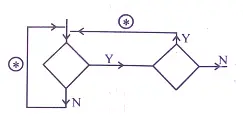
Q: 3 In the diagram given below:

⊛ Indicates ____________ process.
Output
Input
Repetition
Process
[ Option C ]
Q: 4 Which of the following is not a procedural language?
FORTRAN
COBOL
Pascal
PROLOG
[ Option D ]
A procedural language tells the computer how to do something step by step. These languages follow a clear set of instructions.
Q: 5 Generally, the syntax errors are occurred during?
Compile time
Run time
Either (a) or (b)
Both (a) and (b)
[ Option A ]
Syntax Errors occur during Compile Time because the compiler checks the code for correct syntax before converting it into machine code. If there is any violation of syntax rules like missing comma, missing semicolon, missing quotes, wrong brackets, or misspelled keywords, the compiler immediately reports the error and does not allow the program to run until these errors are fixed.
Q: 6 Which language is better for writing structured code?
PASCAL
FORTRAN
BASIC
More than one of the above
[ Option A ]
Structured code means writing programs in an organized way using sequence, selection, loops, and functions or procedures. This style makes a program easier to read, understand, and maintain.
PASCAL is considered the best for writing structured code because it was specially designed for teaching good programming practices. It strongly supports structured programming and encourages programmers to divide the program into clear, logical parts.
Q: 7 Which geometrical figure represents for Input/Output operation of an algorithm?
Diagonal
Circle
Rectangle
Parallelogram
[ Option D ]
In flowchart representations of algorithms, the Parallelogram is used to represent Input-Output operations.
| SYMBOL | USED FOR | DESCRIPTION |
|---|---|---|
| Oval | Start / End | Represents the beginning or termination of a process. |
| Rectangle | Process | Represents a process, task, or operation to be performed. |
| Parallelogram | Input / Output | Represents input or output operations, such as reading data or displaying results. |
| Diamond | Decision | Represents a conditional or decision-making step. |
| Connector | Small Circle | Connects different parts of the flowchart. |
| Arrow | Flowline | Shows the direction of flow from one step to another. |
| Rectangle with wavy base | Document | Represents a document or report. |
| Rectangle with double-struck sides | Predefined Process | Represents a subroutine or predefined process. |
Q: 8 The __________ provides pictorial representation of given problem.
Algorithm
Flowchart
Pseudocode
All of the above
[ Option B ]
A flowchart uses symbols and arrows to show the steps of a problem visually. It is a pictorial (diagrammatically) representation of how a program works.
Q: 9 What does COBOL stands for?
Common Business oriented language
Common object based open source language
C-oriented binary output language
Computer business oriented language
[ Option A ]
COBOL is one of the oldest high-level programming languages, mainly created for handling business-related tasks such as banking, payroll, and financial records. The full form of COBOL is Common Business Oriented Language. It was developed by CODASYL (Conference on Data Systems Languages) in the year 1959.
Q: 10 Which feature of the C language primarily contributed to its widespread adoption in the development of UNIX?
Object-oriented programming support.
Assembly-like speed with high-level abstraction.
Automatic memory management
Platform independent.
[ Option B ]
Q: 11 Which of these statements about the standardization of C is incorrect?
The first standardization of C was ANSI C in 1989.
C was never officially standardized due to its UNIX dependency.
C99 added features like inline functions and new data types.
ISO standardized C after ANSI.
[ Option B ]
Q: 12 The assembly language is
High Level Language
Low Level Language
Use for assemble the PC
Machine Language
[ Option B ]
Assembly Language is considered a low-level language because it is closely related to the machine language instructions executed by the computer hardware.
It uses mnemonic codes such as MOV, CALL, ADD, or SUB instead of binary machine instructions, making it slightly easier for humans to read but still very hardware-specific.
Q: 13 Which one of the following statements is incorrect?
A compiler compiles the source program.
An assembler takes as assembly program as input.
Interpreter executes the complete source code just like compiler.
None of these.
[ Option C ]
A compiler, assembler, and interpreter are all language processing tools (translator), but they work differently.
A compiler reads the entire source program at once, checks it for errors, and then converts it into machine code.
An assembler takes an assembly language program as input and converts it into machine code.
However, an interpreter does not execute the complete source code at once like compiler. Instead, it reads and executes the program line by line, stopping whenever it finds an error.
Q: 14 The extension for C program is ________.
.exe
.clang
.c
.obj
[ Option C ]
When we write a program in the C language, we must save the file with a specific extension so the computer and compiler know it is a C program. The standard file extension for a C program is .c.
| EXTENSION | DESCRIPTION |
|---|---|
| .c | Source code file containing C program statements. |
| .h | Header file containing function declarations, macros, and constants. |
| .obj | Object file generated by the compiler after compiling the .c file. It contains machine code but not yet linked. |
| .exe | Executable file created after linking object files. It can be run on the computer. |
| .lib | Library file containing precompiled functions that can be used in C programs. |
| .i | Preprocessed source file generated after running the preprocessor. |
Q: 15 Machine language is
Machine Dependent
Difficult to program
Error prone
More than one of the above
[ Option D ]
Machine language is the lowest-level language consisting of binary instructions. It is machine dependent, meaning programs written for one type of machine cannot run on another without modification.
It is also difficult to program because it uses only 0s and 1s, making it hard for humans to read or write. Additionally, due to its complexity, it is highly error-prone.
Q: 16 A compiler is a translating program which
Translates instruction of a high-level language into machine language
Translates entire source program into machine language program
It is not involved in program execution
More than one of the above
[ Option D ]
A compiler translates high-level language source code into machine language, processing the entire source program at once to produce an executable machine language program.
Unlike interpreters, compilers are not involved in the execution phase, the compiled program runs independently.
Q: 17 The C language is
A context-free language
A context-sensitive language
A regular language
Parsable fully only by a Turing machine
[ Option A ]
In computer science, programming languages have grammar rules that define how code must be written correctly, similar to English sentence rules.
These grammars fall into Chomsky hierarchy levels:
C language belongs to the class of Context-Free Languages, because its grammar can be described using Context-Free Grammar (CFG).
Q: 18 Who developed C language?
Dennis Ritchie
Guido Van Rossum
Tim Berkel
Von Neumann
[ Option A ]
The C programming language was developed by Dennis Ritchie in 1972 at [AT & T (American Telephone and Telegraph)] Bell Laboratories , USA.
Q: 19 C language developed at ________?
AT & T Bell Laboratories of USA in 1972
AT & T Bell Laboratories of USA in 1970
Cambridge University in 1972
Microsoft in 1970
[ Option A ]
The C programming language was developed by Dennis Ritchie at AT & T Bell Laboratories in the United States. C was introduced in 1972 and became popular because it was simple, fast, and close to the hardware.
Q: 20 A computer program that converts a high-level language program into an equivalent machine language program is called
Assembler
Compiler
Loader
More than one of the above
[ Option B ]
A high-level language like C, C++, Java is human-readable. A compiler is a special program that translates this high-level source code into an equivalent machine language program that the CPU can execute.
| Translator | Description | Translation Method | Example Languages |
|---|---|---|---|
| Compiler | Converts entire program from high-level languages to machine code at once. | Whole program translated before execution. | C, C++, Java |
| Interpreter | Converts and executes program one line at a time from high-level language. | Line-by-line translation and execution. | Python, JavaScript, Perl |
| Assembler | Converts assembly language (low-level) to machine code. | One-to-one mnemonic to machine code translation. | x86 Assembly, ARM Assembly |
Q: 21 A computer program consists of
System flowchart
Program flowchart
Algorithms written in computer language
More than one of the above
[ Option C ]
A computer program is a set of instructions written in a computer language. These instructions are usually based on an algorithm, which is a step-by-step procedure for solving a problem.
Q: 22 A child has to cross road and reach the school opposite to his house. The child looks on right and left before crossing the road. On observing that no vehicle is coming, he crosses the road and reaches school. What action of algorithm is represented by the child in the above situation?
Input
Output
Selection
Repetition
[ Option C ]
The child's action of looking right and left before crossing the road represents a decision-making process. In algorithms, Selection refers to a choice or decision based on a condition.
Q: 23 Which of the following is not a programming language?
Java
C++
Fortran
Lotus
[ Option D ]
Java, C++, and Fortran are all well-known programming languages used to write computer programs.
Lotus is not a programming language. It refers to Lotus 1-2-3, which was a popular spreadsheet software used for calculations and data management, similar to Microsoft Excel.
Q: 24 The languages COBOL and BASIC are commonly known as?
Procedure oriented programming
Object oriented programming
Low level language
None of the above
[ Option A ]
COBOL and BASIC are examples of procedure-oriented programming (POP) languages.
In procedure-oriented languages, a program is divided into functions or procedures. The main focus is on steps (procedures) to perform a task, rather than on objects and data. Data and functions are treated separately.
Q: 25 The ______________ section is used for write comments line in C program.
Link section
Sub-program section
Global declaration section
None of these
[ Option D ]
Comments are those lines which cannot be compiled by the compiler and only used for give the information about the program.
Comments are not necessary in a program. The purpose of comments is only to allow programmer to insert some notes or descriptions to enhance readability or understandability of the program. There are two ways to insert comments in C programs.
SINGLE LINE COMMENTS: For writing single line comments we use // (double forward slash).
Example:
//Program to prints “Suraku Academy”.
MULTIPLE LINE COMMENTS: The multiple line comments placed between delimiters /* and */.
Example:
/* Program for adding two integers.
The value of variable is taken from user at run time. */
However, comments do not belong to any specific section of a C program structure or skeleton. They can be written anywhere in the program.
Q: 26 Which is the only function all C program must contain?
getch()
main()
printf()
Both (a) and (b)
[ Option B ]
Every C program must have one function that acts as the starting point of execution. When a program runs, the compiler and operating system look for this function first. This special function is main(). Without the main() function, the program has no defined entry point, and it cannot execute.
Q: 27 Among the following, which statement is correct about the modularity?
Modularity means hiding the parts of the program.
Modularity refers to dividing a program into subsequent small modules or independent parts.
It refers to overloading the program’s part.
None of the above
[ Option B ]
Modularity in programming is the concept of dividing a large program into smaller, independent, and manageable modules. Each module is designed to perform a specific task and can be developed, tested, and maintained separately. This makes the program easier to understand, debug, and reuse.
Q: 28 Group of instructions that directs a computer is called
Memory
Storage
Program
More than one of the above
[ Option C ]
A computer program is a set of instructions that tells the computer exactly what tasks to perform and in what order.
Q: 29 Header files in C contain:
Compiler commands.
Definition of predefined function.
Declaration of user defined function.
Declaration of predefined function.
[ Option D ]
Header files in C primarily contain the declarations of predefined library functions, such as printf() from stdio.h, getch() from conio.h or sqrt() from math.h. These files also include macro definitions, constants, and type definitions that are needed by the compiler before using any standard function.
Q: 30 The C language is closely associated with
MS-DOS
UNIX
LINUX
MS-WINDOWS
[ Option B ]
The C programming language was developed at AT&T Bell Laboratories, primarily to help develop the UNIX operating system. In fact, UNIX itself was largely rewritten in C to make it portable across different machines.
Q: 31 Which language does a browser use to display information from the World Wide Web?
Machine Code
Assembly Language
C++
None of the above
[ Option D ]
A web browser shows the information from the World Wide Web by reading and interpreting code that websites are written in, like HTML (HyperText Markup Language), CSS (Cascading Style Sheets), and JavaScript. The main part of the browser that does this is called the Rendering Engine.
Machine Code and Assembly Language are low-level languages used by hardware and system programmers, not by browsers. C++ is a high-level programming language used to build software applications.
Q: 32 Following steps are followed for a program written in a high-level language by a computer –
1. The program is compiled into object program.
2. Source program is read and loaded in memory.
3. Compiler reads the program loaded in memory.
4. Machine language routines for reading and writing data.
5. Compiler may be removed from memory.
Choose the answer with correct sequence of steps from the options given below:
2, 3, 1, 4, 5
5, 4, 3, 2, 1
3, 2, 1, 4, 5
4, 5, 1, 2, 3
[ Option A ]
When a program written in a high-level language is processed by a computer, it goes through a systematic sequence of operations:
| STEP | PROCESS DESCRIPTION |
|---|---|
| Source program is read and loaded in memory. | The high-level language code is first read and placed into main memory for compilation. |
| Compiler reads the program loaded in memory. | The compiler analyzes or parses the source code for syntax and semantics. |
| The program is compiled into object program. | The compiler translates the code into an object program (machine-readable). |
| Machine language routines for reading and writing data. | The compiler links standard I/O routines (library functions) for program execution. |
| Compiler may be removed from memory. | Once compilation is done, the compiler is no longer needed and is unloaded. |
Q: 33 A computer program that translate high-level language program into machine language program statement-by-statement is called
Compiler
Loader
Interpreter
More than one of the above
[ Option C ]
An interpreter translates a high-level language program into machine language statement-by-statement. This means it reads one line, converts it, and executes it immediately before moving to the next line.
Q: 34 The program which translates high-level program into its equivalent machine language program is called.
A translator
A language processor
A converter
None of these
[ Option A ]
A computer cannot directly understand programs written in high-level languages such as C, C++, Java, or Python because computers only understand machine language.
These programs need to be changed into machine language, which the computer can understand. The special program that performs this conversion is called a translator.
Q: 35 What was the main limitation of assembly language that led to the creation of C?
Lack of floating-point arithmetic.
No support for low-level memory manipulation.
Poor performance in system-level programming.
Lack of portability and maintainability.
[ Option D ]
Q: 36 Diamond shaped symbol is used in flowcharts to show the___________.
Decision Box.
Statement Box.
Error Box
None of these
[ Option A ]
In a flowchart, different shapes are used to show different types of actions. Each shape has a fixed meaning. A diamond shape is used when the program needs to make a choice (decision).
| SYMBOL | USED FOR | DESCRIPTION |
|---|---|---|
| Oval | Start / End | Represents the beginning or termination of a process. |
| Rectangle | Process | Represents a process, task, or operation to be performed. |
| Parallelogram | Input / Output | Represents input or output operations, such as reading data or displaying results. |
| Diamond | Decision | Represents a conditional or decision-making step. |
| Connector | Small Circle | Connects different parts of the flowchart. |
| Arrow | Flowline | Shows the direction of flow from one step to another. |
| Rectangle with wavy base | Document | Represents a document or report. |
| Rectangle with double-struck sides | Predefined Process | Represents a subroutine or predefined process. |
Q: 37 Which of the following converts the high-level language into machine language?
Opcode
Operand
Compiler
ALU
[ Option C ]
A compiler is a special program that converts a high-level language program into machine language that the computer processor can understand.
The opcode is part of a machine instruction and operand is data on which the operation works.
Q: 38 When a key is pressed on keyboard, which standard is used for converting the keystroke into the corresponding bits?
ANSI
ASCII
EBCDIC
None of the above
[ Option B ]
When you press a key on a standard computer keyboard, the key you press is converted into a unique binary code so that the computer can understand it. The ASCII (American Standard Code for Information Interchange) standard is the one most used for this purpose.
For example:
Q: 39 Which of the following best describes the relationship between C and B languages?
C is a higher-level abstraction of B with support for classes.
C is a simplified version of B designed for embedded systems.
C was derived from B by adding data types and structures.
B was created as an extension to C for system programming.
[ Option C ]
Q: 40 Generally, the logical errors are occurred due to?
Missing semicolon
Poor understanding of program logic
Made any syntax error
All of the above
[ Option B ]
Logical Error occur when the program runs without any error, but the output is incorrect. It happens when the logic or thinking behind the program is wrong.
Logical errors usually occur when a programmer uses the wrong formula, writes incorrect if-else or loop conditions, uses wrong operators, or designs a faulty algorithm. All of which come from poor understanding of the required logic.
Q: 41 _______ is a procedure or step by step process for solving a problem.
Algorithm
Flowchart
Pseudocode
None of these
[ Option A ]
An algorithm is a simple step-by-step procedure used to solve a problem. It is written in plain and easy language so that anyone can understand the sequence of actions to be performed.
E.g.:
Write an algorithm to find sum of first N natural number.
| Algorithm: [ADD FIRST N NATURAL NUMBER] Step 1: Start. Step 2: [Initialize.] Set SUM:=0, I:=1 Step 3: [Input Value of N] Read N Step 4: [Loop.] Repeat Step 5 and 6 while I<=N Step 5: SUM:=SUM+I. Step 6: [Increase Counter] I:=I+1 Step 7: [Display Result] Print SUM Step 8: Exit. |
Q: 42 A block is enclosed within a pair of:
( )
{ }
[ ]
< >
[ Option B ]
In C programming, a block refers to a group of statements enclosed within a pair of curly braces { }. These braces define the beginning and end of a compound statement.
Blocks are commonly used in functions, decision-making, loops, and other control structures to group multiple statements together so they execute as a single unit.
Q: 43 An assembly language is a/an
Low-level programming language
Middle-level programming language
Internet-based programming language
None of the above
[ Option A ]
Assembly language is considered a Low-Level programming language because it is only one step above machine language. It uses mnemonic codes like MOV, ADD, and SUB instead of binary, making it slightly easier for humans to read but still closely tied to the hardware architecture.
Q: 44 Select the true statement for compiler.
The input of the compiler is source program.
It translates the source code into object code as a whole.
The output of the compiler is object code.
More than one of the above
[ Option D ]
A compiler is a program that translates a high-level language into machine-readable code.
A source program is the code written by the programmer in a high-level language. The compiler takes this source code and converts it into object code, which is in machine language.
So, all three options (a), (b), and (c) are true for a compiler.
Q: 45 The _________ symbol is used at the beginning of a flow chart.
Rectangle
Oval
Diamond
Arrow
[ Option B ]
In flowchart, the oval shape is used to represent the Start and End of a flowchart. Since every flowchart must begin with a starting point, the oval symbol is placed at the very beginning to indicate where the process starts.
Q: 46 Which of the following is NOT a feature of the C language?
Structured Programming.
Recursion.
Garbage Collection.
Low-Level Memory Access.
[ Option C ]
Q: 47 Which of the following programming language is used to write queries in database applications?
Fortran
SQL
Python
None of these
[ Option B ]
Databases store and manage large amounts of data. To perform operation with this data like inserting, updating, deleting, or searching information, we need a special language called SQL (Structured Query Language).
SQL is specifically designed for writing queries, which are commands that help us interact with a database.
Thank you so much for taking the time to read my Computer Science MCQs section carefully. Your support and interest mean a lot, and I truly appreciate you being part of this journey. Stay connected for more insights and updates! If you'd like to explore more tutorials and insights, check out my YouTube channel.
Don’t forget to subscribe and stay connected for future updates.