
What is Memory Leakage in C Programming?
Dynamic memory allocation is one of the most powerful features of the C programming language. Functions such as malloc(), calloc(), and realloc() allow programmers to allocate memory during program execution whenever it is required. However, this flexibility also comes with an important responsibility. Every dynamically allocated memory block must be released using the free() function when it is no longer needed.
If a program allocates memory but fails to release it, the allocated memory remains occupied even though the program can no longer use it. This situation is known as Memory Leakage. Memory leakage is one of the most common programming mistakes in C and is frequently asked in competitive examinations, interviews, and university practical exams.
free(). As a result, the occupied memory cannot be reused until the program terminates.Why Does Memory Leakage Occur?
Memory leakage mainly occurs when memory is allocated from the heap but is never released. Since the operating system considers that memory as already allocated, it cannot be assigned to other parts of the program. Over time, repeated memory leaks gradually consume the available heap memory, which can slow down the application or even cause it to crash.
A memory leak is often called a silent bug because the program usually compiles and executes successfully without showing any immediate error or warning. The problem becomes noticeable only after the application runs for a long time or repeatedly allocates memory.
Understanding Heap and Stack Memory
To understand memory leakage, it is important to know the difference between the Stack and the Heap. These two memory regions are managed differently and play different roles during program execution.
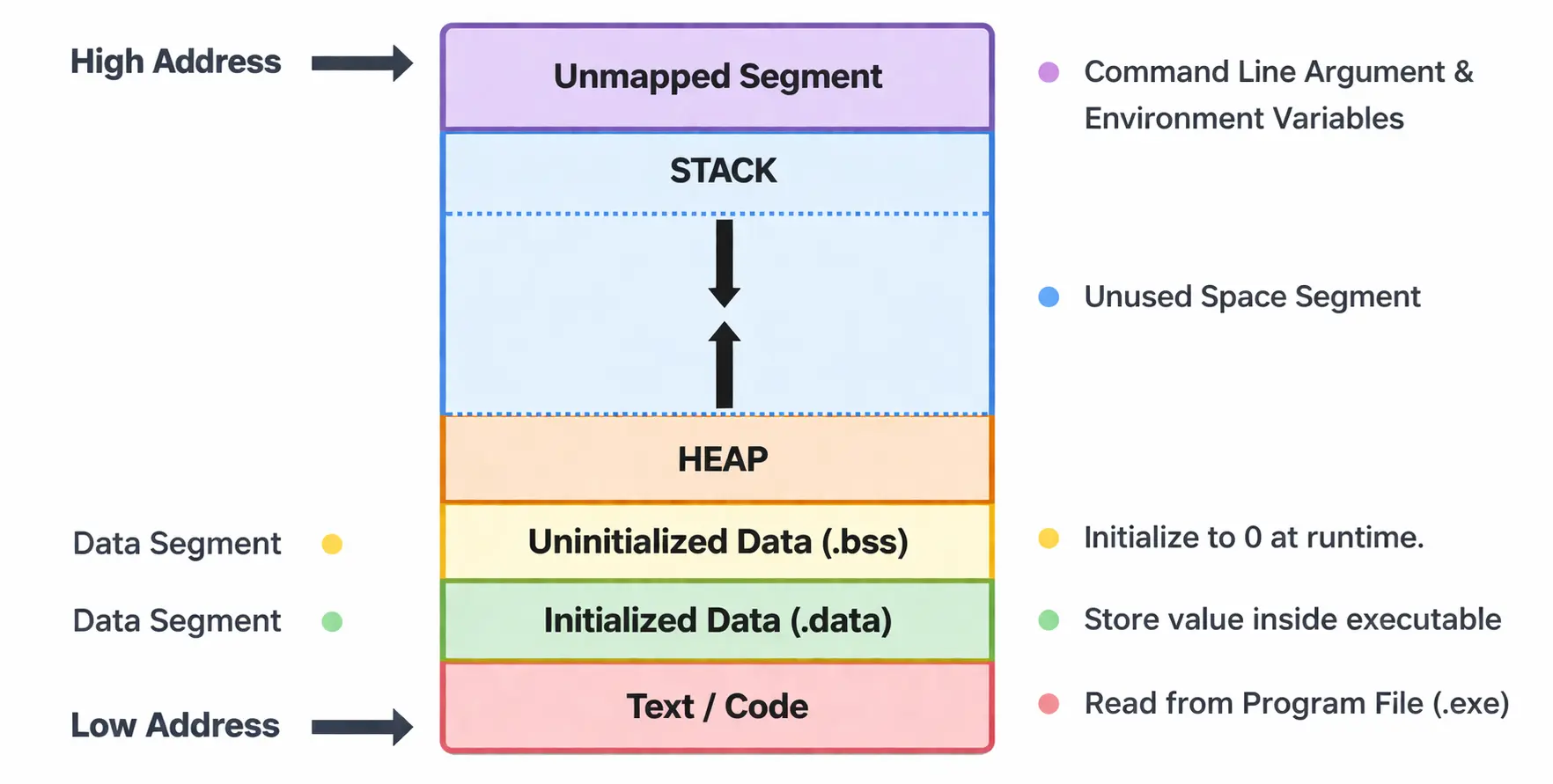
| Feature | Stack Memory | Heap Memory |
|---|---|---|
| Purpose | Stores local variables, function parameters, and return addresses. | Stores dynamically allocated memory. |
| Memory Management | Managed automatically by the compiler. | Managed manually by the programmer. |
| Allocation | Automatic during function execution. | Using malloc(), calloc(), or realloc(). |
| Deallocation | Automatic when the function finishes. | Must be released explicitly using free(). |
| Memory Leak Possible? | No | Yes |
Basic Example of Memory Leakage
Consider the following program.
#include <stdio.h>
#include <stdlib.h>

int main()
{
    int *ptr = (int *)malloc(5 * sizeof(int));
    /* Program Logic */
    return 0;
}
In this program, memory is successfully allocated using malloc(). However, the allocated memory is never released because the free(ptr); statement is missing.
When the program reaches the end, the pointer variable disappears, but the allocated heap memory remains occupied until the operating system cleans it up after program termination. In long-running applications such as servers or embedded systems, this unreleased memory continues to accumulate, eventually causing serious memory wastage.
free(). This is a classic example of Memory Leakage.Correct Way to Prevent Memory Leakage
The solution is simple. Every dynamically allocated memory block should be released once it is no longer required.
#include <stdio.h>
#include <stdlib.h>

int main()
{
    int *ptr = (int *)malloc(5 * sizeof(int));
    /* Program Logic */
    free(ptr);
    ptr = NULL;
    return 0;
}free() after using dynamically allocated memory. It is also recommended to set the pointer to NULL after freeing it to avoid accidentally accessing invalid memory.Quick Revision
- Memory leakage occurs only with dynamically allocated (heap) memory.
- The compiler does not automatically release heap memory.
- Every call to
malloc(),calloc(), orrealloc()should have one correspondingfree(). - Failure to release heap memory results in memory leakage.
- Memory leakage is one of the most frequently asked topics in C programming interviews and competitive examinations.
Common Causes of Memory Leakage
Memory leakage does not occur only when programmers forget to call free(). In real-world applications, there are several situations that can make allocated memory inaccessible. Understanding these scenarios helps you write safer and more efficient C programs.
1. Forgetting to Call free()
The most common reason for memory leakage is forgetting to release dynamically allocated memory after its use.
int *ptr = (int *)malloc(sizeof(int));

*ptr = 100;

/* Missing free(ptr); */2. Losing the Pointer Reference
Sometimes memory is allocated correctly, but the pointer is reassigned to another address before the previously allocated memory is released.
int *ptr = (int *)malloc(sizeof(int));

ptr = (int *)malloc(sizeof(int));malloc() is lost permanently because ptr now points to a new memory block. Since the original address is no longer available, that memory cannot be freed, resulting in a memory leak.3. Returning Without Releasing Memory
A function may allocate memory and return before calling free().
void display()
{
    int *ptr = (int *)malloc(100);
    if(ptr == NULL)
        return;
    return;
    free(ptr);
}free(), the allocated memory is never released.4. Memory Leak Inside Loops
Memory leaks become much more serious when allocation happens inside a loop. Every iteration allocates new memory, but none of it is released.
for(int i = 0; i < 1000; i++)
{
    int *ptr = (int *)malloc(sizeof(int));

    /* Missing free(ptr); */
}Summary of Common Memory Leak Situations
| Situation | Cause | Memory Leak? |
|---|---|---|
Forgot to call free() | Allocated memory is never released. | Yes |
| Pointer reassigned | Original memory address is lost. | Yes |
| Function returns early | free() statement is skipped. | Yes |
Allocation inside loop without free() | Memory keeps accumulating. | Yes |
| Stack Variables | Released automatically when function ends. | No |
Real-Life Analogy
Imagine checking into a hotel room. As long as you officially check out, the room becomes available for the next guest. However, if you leave without informing the hotel, the room remains reserved even though nobody is using it.
Memory leakage works in the same way. The program stops using the allocated memory, but because it never informs the operating system by calling free(), that memory remains occupied and unavailable for future allocations.
- malloc() = Book a room.
- Use Memory = Stay in the room.
- free() = Check out properly.
- No free() = Room stays blocked even after leaving.
How to Avoid Memory Leakage
Following a few simple programming practices can prevent most memory leaks and improve the reliability of your applications.
- Always call
free()after completing the work with dynamically allocated memory. - Assign
NULLto pointers after freeing them. - Avoid overwriting pointer variables before releasing the previous memory block.
- Release allocated memory before returning from a function.
- Be extra careful while allocating memory inside loops.
- Test large applications using memory debugging tools such as Valgrind.
Quick Revision
- The most common cause of memory leakage is forgetting to call
free(). - Pointer reassignment can permanently lose the address of allocated memory.
- Memory allocated inside loops should always be released within the loop or immediately after its use.
- Returning from a function before calling
free()also causes memory leakage. - Good memory management improves both program performance and reliability.
Why is Memory Leakage Dangerous?
A small memory leak may not create an immediate problem, especially in programs that run for only a few seconds. However, in applications that execute continuously, such as web servers, operating systems, database systems, embedded devices, and real-time software, memory leakage can become a serious issue.
Whenever memory is allocated but not released, the available heap memory gradually decreases. As the program continues running, more and more memory becomes unavailable for reuse, which eventually affects the performance and stability of the application.
Effects of Memory Leakage
| Effect | Description |
|---|---|
| Increased Memory Usage | The application continuously consumes more RAM because unreleased memory keeps accumulating. |
| Reduced Performance | As available memory decreases, the operating system spends more time managing memory, resulting in slower execution. |
| Application Crash | If sufficient memory is not available, future memory allocation requests may fail, causing unexpected program termination. |
| System Instability | Multiple applications suffering from memory leaks can reduce the overall performance of the entire operating system. |
| Poor User Experience | Applications may become slow, unresponsive, or freeze after running for a long period. |
Memory Leak vs Dangling Pointer
Students often confuse Memory Leakage with a Dangling Pointer. Although both involve pointers, they represent completely different problems.
| Memory Leakage | Dangling Pointer |
|---|---|
| Allocated memory is never released. | The memory has already been released, but the pointer still refers to that location. |
| Memory remains occupied unnecessarily. | The pointer refers to invalid memory. |
| Causes wastage of memory. | May cause undefined behavior when accessed. |
| Memory cannot be reused until released. | Memory is already available for reuse. |
Solved using free(). | Solved by assigning the pointer to NULL after calling free(). |
- Memory Leak ? Memory exists but cannot be accessed.
- Dangling Pointer ? Pointer exists but the memory no longer exists.
Memory Leak vs Memory Fragmentation
Memory leakage and memory fragmentation are different memory management problems, although both can reduce the efficiency of a program.
| Memory Leakage | Memory Fragmentation |
|---|---|
| Occurs when allocated memory is never released. | Occurs when free memory is divided into many small blocks. |
| Results in permanent loss of usable memory. | Enough total memory may exist, but it is not available as one continuous block. |
| Mainly caused by programming mistakes. | Usually caused by repeated allocation and deallocation of different-sized memory blocks. |
| Fixed by releasing unused memory. | Reduced by efficient memory allocation strategies. |
How to Detect Memory Leaks?
Finding memory leaks manually becomes difficult in large software projects. Therefore, programmers use specialized debugging tools that monitor memory allocation and report unreleased memory blocks.
- Valgrind – One of the most popular memory debugging tools for Linux.
- AddressSanitizer (ASan) – Available with GCC and Clang compilers.
- Visual Studio Diagnostic Tools – Useful for detecting memory leaks in Windows applications.
- LeakSanitizer (LSan) – Detects leaked heap memory during program execution.
Best Practices for Safe Dynamic Memory Management
- Allocate memory only when it is actually required.
- Release every allocated memory block exactly once.
- Always assign
NULLto pointers after callingfree(). - Never overwrite a pointer before releasing its previous memory.
- Check whether
malloc()orcalloc()returnsNULLbefore using the allocated memory. - Use memory debugging tools while testing large applications.
- Review your code carefully whenever dynamic memory allocation is used.
Quick Revision
- Memory leakage gradually reduces available heap memory.
- Long-running applications are most affected by memory leaks.
- Memory leakage and dangling pointers are different problems.
- Memory fragmentation is also different from memory leakage.
- Tools like Valgrind and AddressSanitizer help detect memory leaks efficiently.
Frequently Asked Questions (FAQs)
1. What is Memory Leakage in C Programming?
free() function. As a result, the memory remains occupied and cannot be reused until the program terminates.2. Why does memory leakage occur?
free(), overwrite a pointer before releasing its memory, or return from a function without freeing dynamically allocated memory.3. Does memory leakage occur in stack memory?
4. How can memory leakage be prevented?
free(), avoid overwriting pointers, assign NULL after freeing memory, and use memory debugging tools during development.5. Which tools are used to detect memory leaks?
Common Interview Questions
- What is memory leakage in C?
- Why does memory leakage occur?
- How is memory leakage different from a dangling pointer?
- Can memory leakage occur in stack memory?
- Why is calling
free()important? - What happens if dynamically allocated memory is never released?
- Which tools are commonly used to detect memory leaks?
- Why are long-running applications more affected by memory leakage?
Important Exam Points
- Memory leakage occurs only in heap memory.
- Heap memory is managed manually by the programmer.
- Every
malloc(),calloc(), orrealloc()should have one correspondingfree(). - Memory leakage is a runtime problem.
- Memory leakage gradually reduces available heap memory.
- Memory leakage is different from a dangling pointer.
- Stack memory is automatically released when a function returns.
- Valgrind is one of the most commonly used memory debugging tools.
Conclusion
Memory leakage is one of the most important concepts in dynamic memory management. Although a program with memory leaks may appear to work correctly, unreleased heap memory gradually reduces the available system memory and can eventually affect application performance and stability.
Every programmer should develop the habit of releasing dynamically allocated memory immediately after it is no longer required. Following proper memory management practices not only improves program efficiency but also makes software more reliable, scalable, and easier to maintain.
For competitive examinations such as UGC NET, SET, PGT, TGT, Computer Instructor, DSSSB, university examinations, and technical interviews, understanding memory leakage is essential because questions are frequently asked about its causes, prevention techniques, and comparison with other memory-related concepts.
Final Revision
- Memory leakage occurs when dynamically allocated memory is not released.
- It affects only heap memory.
- The
free()function releases allocated memory. - Assign pointers to
NULLafter callingfree(). - Long-running applications are most vulnerable to memory leaks.
- Memory leakage is different from dangling pointers and memory fragmentation.
- Use debugging tools such as Valgrind and AddressSanitizer to detect memory leaks.
Understanding memory management requires both theoretical knowledge and practical coding experience. Practice writing programs using malloc(), calloc(), realloc(), and free() to strengthen your understanding. Regular practice with previous year questions and coding exercises will help you confidently solve memory management problems in examinations and technical interviews.